 Sanhua
Expansion Valves
Sanhua DPF7.5 Electronic Expansion Valve – DPF(S03)7.5C-01
Sanhua DPF7.5Part No. DPF(S03)7.5C-01
Contact for availability
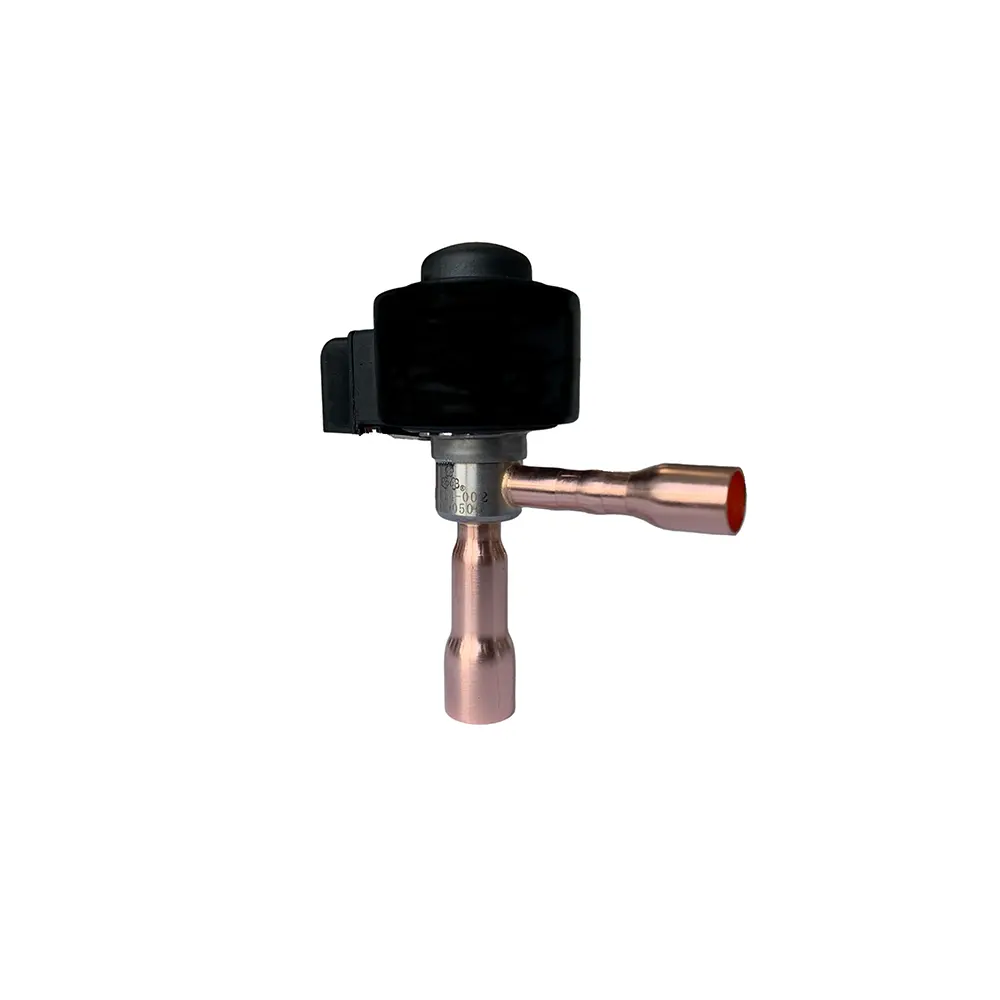
Representative product image. Confirm the exact configuration before ordering.
Sanhua DPF3.0 500-step bidirectional electronic expansion valve, model DPF(TS1)3.0C-29, Kv 0.39 m³/h and 32.5 kW nominal R410A capacity. 12 VDC stepper drive; PQ-M10 coil family.
Wholesale pricing and lead time on request.
Sanhua DPF3.0 Electronic Expansion Valve – DPF(TS1)3.0C-29 is a compact electronic expansion valve for precise refrigerant-flow modulation in air-conditioning, refrigeration and reversible heat-pump systems. Sanhua lists this exact valve as DPF(TS1)3.0C-29. Under the catalogue rating condition (Tc 38°C, Te 5°C, SC 0°C and SH 0°C), its nominal R410A cooling capacity is 32.5 kW and its Kv is 0.39 m³/h.
The DPF-TS/S family uses a direct-acting permanent-magnet stepper motor to position the valve electronically. The family provides 500 full-stroke steps and supports bidirectional refrigerant flow, making it suitable for systems where operating load and refrigerant direction can change. Electronic modulation allows the controller to adjust valve opening from live system inputs rather than relying on a mechanical thermostatic power element.
DPF3.0 sits at a specific point in the DPF capacity range: it combines a Kv of 0.39 m³/h with catalogue nominal capacities of 27.8 kW on R22, 21.7 kW on R134a, 28.6 kW on R407C, 19.4 kW on R404A/R507, 32.5 kW on R410A, 47.7 kW on R32 and 28.8 kW on R290. This makes model-level selection important; two DPF bodies that look similar should not be treated as interchangeable without checking capacity, pressure differential, coil/driver requirements and the complete valve code. For a smaller DPF capacity step, compare DPF2.4. For a larger DPF capacity step, compare DPF3.2.
| Brand | Sanhua |
|---|---|
| Series | DPF3.0 |
| Exact catalogue model | DPF(TS1)3.0C-29 |
| Valve type | Electronic Expansion Valve (EEV) |
| Full stroke | 500 steps |
| Opening reference | 32 ± 20 steps |
| Kv | 0.39 m³/h |
| Maximum operating pressure | 4.2 MPa |
| MOPD, direct flow | 3.5 MPa |
| MOPD, reverse flow | ≥1.5 MPa |
| Rated coil voltage | 12 VDC ±10% |
| Actuation | 4-phase, 8-step permanent-magnet stepper motor; direct acting |
| Excitation | 1–2 phase, unipolar |
| Excitation rate | 30–40 pps |
| Coil current | 260 mA/phase at 20°C |
| Coil resistance | 46 ± 3.7 Ω/phase at 20°C |
| Coil protection | IP67 |
| Coil insulation class | E |
| Medium temperature | -40°C to +70°C (catalogue duty-cycle condition applies) |
| Ambient temperature | -30°C to +60°C (catalogue duty-cycle condition applies) |
| Relative humidity | 0–95% RH |
| Refrigerant | Nominal capacity |
|---|---|
| R22 | 27.8 kW |
| R134a | 21.7 kW |
| R407C | 28.6 kW |
| R404A / R507 | 19.4 kW |
| R410A | 32.5 kW |
| R32 | 47.7 kW |
| R290 | 28.8 kW |
Catalogue rating condition: condensing temperature 38°C, evaporating temperature 5°C, subcooling 0°C and superheat 0°C. Actual valve selection must be checked at the real system conditions.
The coil must be matched to the valve body and controller. For this DPF3.0 configuration, the catalogue identifies the PQ-M10 coil family. Do not select a coil only by appearance.
A thermostatic expansion valve such as the Danfoss T2/TE2, TR6 or TGE uses a mechanical thermostatic power element to regulate superheat. The Sanhua DPF instead uses a stepper motor and an electronic controller. A TXV can be simpler because it does not require an EEV driver and electronic sensing strategy; the DPF gives the control system direct command of valve position and is especially useful where load varies, tighter electronic control is required or refrigerant flow reverses. These technologies should not be treated as direct replacements without engineering selection.
DPF should also not be selected merely by comparing physical size with another EEV. Different electronic valves can use different step counts, motor drive methods, pressure limits, flow coefficients and controller requirements. For comparison, SYREF also lists Danfoss ETS 12C electronic expansion valve and Danfoss ETS 100C electronic expansion valve. A Sporlan SEHI/SERI or another Sanhua EEV may serve a similar control function, but compatibility must be established from capacity, refrigerant, MOPD, connection size, controller output and motor specification—not from the generic term “electronic expansion valve.”
Before ordering DPF(TS1)3.0C-29, confirm the complete model code, refrigerant, required capacity, evaporating and condensing temperatures, subcooling, superheat, pressure drop, flow direction, connection dimensions, controller/driver output and the required PQ-M10 coil configuration. For replacement work, verify the existing controller’s motor-drive compatibility before assuming the valve is a drop-in substitute.
Sanhua specifies the coil in the upward position with the rotor central axis within ±15° of vertical. The inlet is preferably arranged sideways and the outlet downward. Follow the current manufacturer installation instructions and system cleanliness/brazing practices when installing the valve.
Send SYREF the required model, quantity, refrigerant, operating conditions and destination for availability, technical confirmation and quotation.
Technical source: Sanhua Standard Product Catalogue 2026 – APA Region, DPF-TS/S Series.
| Specification | Value |
|---|---|
| Valve Type | Electronic Expansion Valve (EEV) |
| Exact Model | DPF(TS1)3.0C-29 |
| Kv | 0.39 m³/h |
| R410A Nominal Capacity | 32.5 kW |
| Full Stroke | 500 steps |
| Rated Voltage | 12 VDC ±10% |
| Compatible Coil Family | PQ-M10 |
| Max Operating Pressure | 4.2 MPa |
| MOPD Direct | 3.5 MPa |
| MOPD Reverse | ≥1.5 MPa |
Verify final specifications against the full manufacturer order code and current datasheet. Share your refrigerant, voltage and application when requesting a quote.
It electronically meters refrigerant in air-conditioning, refrigeration and heat-pump systems using a compatible controller and stepper-motor drive.
The 2026 Sanhua catalogue identifies this configuration as DPF(TS1)3.0C-29 .
The applicable catalogue coil family is PQ-M10 . The exact coil order code and cable length must be selected for the installation; compatible order codes are listed above.
Not as a simple drop-in replacement. DPF requires compatible electronic control and its capacity, pressure limits, connections, sensors and controller strategy must be engineered for the system.
Only after verifying refrigerant capacity, Kv, MOPD, connections, stepper-motor drive, controller compatibility and operating conditions. Similar appearance does not establish interchangeability.
SanhuaPart No. DPF(S03)7.5C-01
SanhuaPart No. DPF(S03)7.0C-01
SanhuaPart No. DPF(S03)6.5C-02
SanhuaPart No. DPF(S03)5.5C-01