How to Identify the Correct HVAC Replacement Part by Model and Part Number
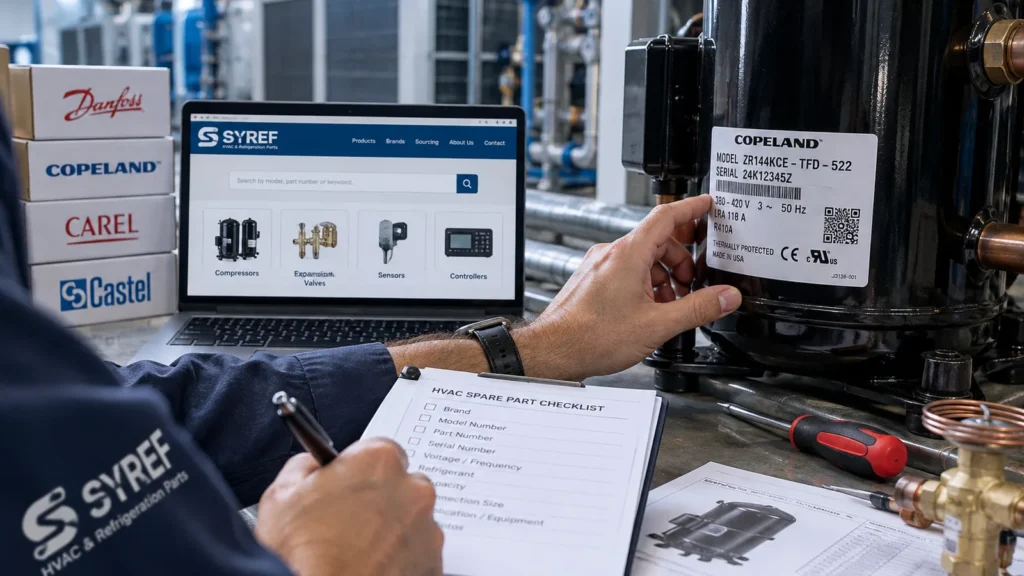
Selecting the correct replacement part is one of the most important steps in HVAC and refrigeration maintenance. A component that looks physically identical may have a different capacity, voltage, connection size, refrigerant compatibility, pressure rating or control signal.
For this reason, professional HVAC sourcing should begin with the manufacturer, model number and part number rather than appearance alone. In this guide, the SYREF technical team explains how to identify HVAC and refrigeration spare parts accurately before requesting a quotation or placing an order.
Why the Part Number Matters
The part number is normally the most precise identifier assigned by the manufacturer to a specific product configuration. Two components from the same product family can have very similar housings while having completely different technical specifications.
For example, electronic expansion valves from the same series may differ in:
Flow capacity
Connection size
Maximum working pressure
Motor or coil specification
Refrigerant compatibility
Valve configuration
Controller compatibility
Whenever possible, provide the complete part number exactly as it appears on the product label or nameplate. Do not remove letters, dashes, suffixes or revision codes.
Model Number vs Part Number
A model number usually identifies a product series or general configuration, while a part number can identify a more specific factory configuration.
Depending on the manufacturer, one model may be available with several different part numbers for different connections, voltages, capacities or accessories.
When searching the SYREF HVAC and refrigeration parts catalog, entering both identifiers provides the best chance of finding the correct component.
1. Check the Manufacturer Name
Start by identifying the original manufacturer. Brand information is normally printed on the label, casting, electrical enclosure or product packaging.
SYREF sources industrial HVAC and refrigeration components from manufacturers including Danfoss, Copeland, Bitzer, Carel, Castel, Sporlan, Sanhua, Hanbell and other established brands.
You can browse available manufacturers on the SYREF Brands page.
2. Read the Complete Nameplate
A product nameplate can contain much more useful information than the model number alone. Before contacting a supplier, record every readable field.
Important information may include:
Brand
Model number
Part number
Serial number
Voltage
Frequency
Pressure range
Refrigerant
Connection size
Capacity
Manufacturing revision
For compressors, controllers, sensors and electronic expansion valves, even one missing suffix can indicate a different version.
3. Take Clear Photos of the Product
When the exact identification code is unclear, clear photographs are extremely useful. Take at least one close-up photograph of the nameplate and one photograph showing the complete component.
For valves and mechanical parts, also photograph the inlet and outlet connections. For electrical components, photograph connectors, terminals and wiring labels.
If you cannot identify the component, you can send the available information through the SYREF sourcing service.
4. Confirm the Technical Specifications
Never approve a replacement component based only on a similar model name. The technical specification should be compared with the original system requirements.
For Compressors
Check:
Compressor technology: scroll, screw or reciprocating
Refrigerant
Nominal capacity
Voltage and frequency
Connection size
Oil type
Operating envelope
For Expansion Valves
Check:
Valve capacity
Refrigerant
Inlet and outlet connection size
Maximum pressure rating
Actuator or coil specification
Controller compatibility
For Sensors and Pressure Transducers
Check:
Pressure or temperature range
Output signal such as 4–20 mA or 0.5–4.5 V
Supply voltage
Electrical connector
Mechanical connection
5. Be Careful With Similar-Looking Parts
Visual similarity does not guarantee interchangeability. Manufacturers often use the same housing across several capacities or electrical configurations.
This is especially common with:
Electronic expansion valves
Pressure switches
Controllers
Pressure sensors
Solenoid valves
Compressors within the same series
Always compare identification codes before ordering.
6. Check Whether the Original Part Has Been Superseded
Older HVAC equipment may contain parts that are no longer manufactured. In these cases, the original manufacturer may replace an old part number with a newer equivalent or successor model.
A proper replacement should be checked for:
Mechanical compatibility
Electrical compatibility
Capacity
Pressure rating
Refrigerant compatibility
Required controller or accessory changes
Do not assume that a newer model is automatically a direct replacement.
7. Provide System Information When the Part Number Is Missing
Sometimes the product label is damaged or completely unreadable. In this situation, system information can help narrow down the correct replacement.
Useful information includes:
Equipment manufacturer
Chiller or refrigeration unit model
Refrigerant type
Cooling capacity
Voltage
Pipe size
Application
Photos of the original component
A Practical Example
Imagine that an electronic expansion valve is removed from a refrigeration system. The technician can read only the manufacturer and part of the model number.
Instead of ordering another valve with the same physical dimensions, the correct process is to:
Identify the manufacturer.
Photograph the nameplate.
Record all readable model characters.
Measure the pipe connections.
Identify the refrigerant.
Check the controller used with the valve.
Compare the information with the manufacturer's technical documentation.
This process significantly reduces the risk of ordering an incompatible component.
What Information Should You Send When Requesting a Quote?
To speed up identification and quotation, send as much of the following information as possible:
Manufacturer
Exact model number
Exact part number
Required quantity
Clear nameplate photo
Complete product photo
Destination country
Any required technical specification
You can also browse our HVAC and refrigeration parts catalog before submitting your inquiry.
Can't Find the Exact Part?
Not every industrial HVAC component can be listed online. Older parts, discontinued models and specialized configurations may require manual sourcing.
If the required model is not currently listed, use the SYREF China sourcing service and send the model, part number or nameplate photograph.
For additional assistance, you can also contact the SYREF team.
Conclusion
The safest way to identify an HVAC replacement part is to combine the manufacturer name, model number, part number, technical specifications and clear photographs.
Checking these details before ordering reduces compatibility problems, avoids unnecessary shipping costs and helps ensure that the replacement component matches the original system requirements.
SYREF helps international HVAC and refrigeration businesses identify and source industrial spare parts directly from China. Browse the SYREF product catalog or submit a sourcing request for components that are difficult to locate.
Frequently Asked Questions
Is the model number enough to identify an HVAC spare part?
Not always. Some manufacturers use the same model family for several configurations. Whenever possible, provide both the model number and the complete part number.
Can two HVAC parts look identical but have different specifications?
Yes. Components with identical housings can have different capacities, voltage ratings, pressure ranges, connections or control specifications.
What should I do if the nameplate is damaged?
Send clear photos of the component together with system information such as manufacturer, equipment model, refrigerant, voltage, connection size and application.
Can SYREF source a part that is not listed in the catalog?
Yes. SYREF provides sourcing support for industrial HVAC and refrigeration components that are not currently listed in the online catalog.
Get help sourcing your part ↗